

 укр
укр  eng
eng 

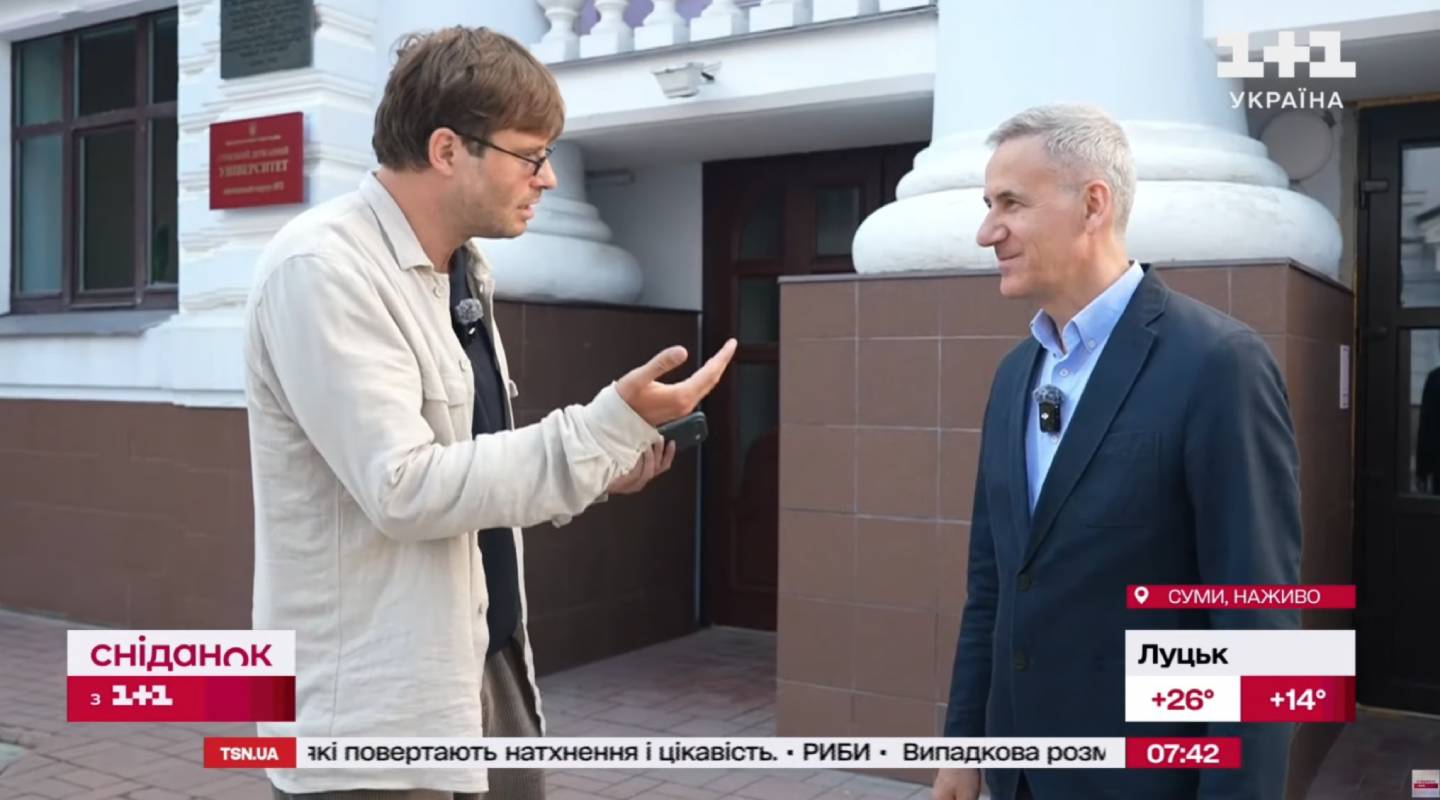
Despite its proximity to front lines, damaged buildings, and constant security threats, SumDU is holding high positions in Ukrainian and international higher education rankings. Vasyl KARPUSHA (SumDU rector) spoke for the program “Breakfast with 1+1” about how the university manages not only to operate but also to develop amid the war.
According to the rector, university’s success is no accident but result of many years of systematic work and team cohesion.
“Before the war, we were always among leaders. Our work is based not on philosophy of survival, but on philosophy of development. Despite all circumstances, are moving forward,” – emphasized Vasyl KARPUSHA.
International rankings evaluate universities based on research activity, international cooperation, community impact, and sustainable development achievements. It is precisely in these areas that SumDU consistently demonstrates high results.
One indicator of university’s impact on regional development is training of specialists for local community. According to the rector, about 85% of doctors currently working in Sumy are SumDU graduates.
Scientific activity remains an important component of development. Funding for university science has nearly tripled during the war. Part of the funds comes from government programs, but a significant portion comes from business and international projects.
“These are not subsidies. Businesses commission specific research, IT solutions, and scientific developments. Businesses pay for a product that helps them be more successful,” – explained the rector.
This year alone, SumDU researchers secured 27 new state-funded research projects, one of the best records among Ukrainian universities.
Despite security challenges, the university maintains an active student life. Students participate in grant programs, implement their own initiatives, and create new youth spaces. Recently, a student team has secured funding to set up a youth center.
Separately, Vasyl KARPUSHA refuted the widespread notion that public universities lack flexibility compared to private institutions.
“Opportunities to develop modern educational programs are the same for everyone. The issue is not the university’s status, but how effectively the team utilizes academic autonomy,” – he noted.
Speaking about Sumy, the rector argued that despite the war, the city continues to live, develop, and change. New establishments are opening here, internally displaced persons and military families are arriving, and a new energy is forming within the community.
“People in Sumy don’t mope,” – concluded Vasyl KARPUSHA.
Currently, the university estimates the cost of restoring damaged infrastructure at approximately half a billion hryvnias. At the same time, SumDU is convinced that the university’s greatest asset is not its buildings, but the people who continue to teach, learn, research, and develop the university even in the midst of war.