

 укр
укр  eng
eng 

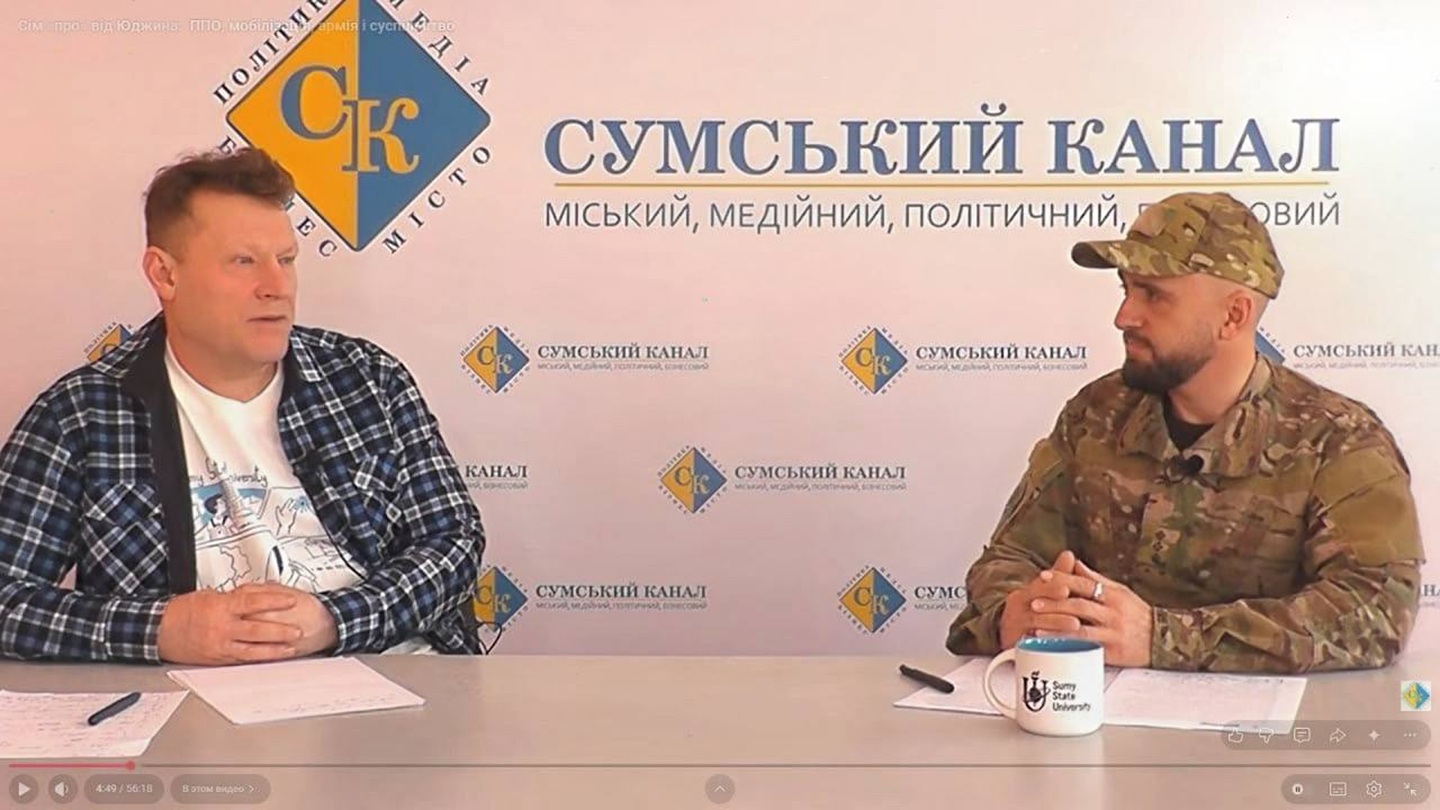
How can a university near the front line become a space for societal renewal and a generator of new meaning? Today, SumDU is actively pursuing its “third mission,” specifically by helping defenders and their families find new horizons in life through education and leadership. We speak with Oleh TULIAKOV (director of the SumDU Center for Veteran Development) about practical steps toward reintegration, collaboration with communities, and why veterans will become the leaders of change in the country.
Mr. Oleh, your work as head of the Center for Veteran Development didn’t start with office meetings and conferences, but with live streams on a YouTube channel. Why did you choose this particular public and media-oriented format to “kick things off”?
I am convinced that modern veteran policy cannot begin solely with bureaucracy. It must begin with a live conversation. And any institution planning to address veteran issues must first establish a solid connection and initiate socially meaningful interaction with the target group.
Today, society is undergoing not only a military transformation but also a profound social and psychological one. And in such conditions, it is extremely important to bring veterans back into the public sphere – not just as “recipients of aid”, but as people with experience, a voice, and a clear path to being heard and engaged.
That is precisely why we chose the format of an open media dialogue. YouTube livestreams have become our attempt to create a space of trust between veterans, young people, university, and community. Right now, Ukraine critically needs to restore horizontal connections between people. Sometimes, a single honest conversation can do more for society than dozens of official documents.
Moreover, the modern world largely exists in the media space. This began with the pandemic – discourses shifted to the media sphere, which significantly limited influence of other communication formats. If a university wants to be an active participant in social processes, it cannot remain merely an academic institution in the narrow sense. The university must become a space for meaning, discussion, and public dialogue.
You’ve already had a chance to speak on air with several veterans. What is the dominant emotion or thought in these conversations? What hurts defenders returning to civilian life the most right now?
I was struck by the fact that there is almost no grandstanding in these conversations. Instead, there is a great deal of responsibility, inner composure, and a desire to define their place in the country’s future. Fragments of conversations about combat experience are filled with profound emotions regarding the present and the future.
Currently, many veterans find themselves in a state that the German philosopher Karl Jaspers called a “borderline situation”. The thinker believed that it is precisely in such extreme experiences – war, suffering, loss, struggle – when a person begins to truly rethink themselves and the world. He wrote: “To experience borderline situations and to exist are one and the same”. We see a paradox – the path to true development can be found in a state of critical experiences.
War changes a person very drastically. And upon returning to civilian life, a veteran often faces not only everyday difficulties but a deeper question: how to live on, what now constitutes their place and meaning of their participation in society. Therefore, veteran policy should not be reduced merely to a system of benefits or administrative support. It is about something much deeper – creating a space where a person can rethink their own experience and transform it into a force for development of community and state.
Therefore, one of the main challenges for a veteran after the war is not just physical recovery and adaptation. It is a question of meaning and social role. A person who has been through war feels the question very acutely: “What’s next?” And if society does not offer a space to put this experience into practice, a dangerous sense of isolation will arise.
At the same time, I see something else. Many veterans possess enormous potential for leadership, self-organization, and responsibility. These are people who, under critical conditions, have learned to act, make decisions, and work as a team. And it seems to me that Ukraine has not yet fully realized just how powerful a resource for community development the veteran community can become.
Did this YouTube project become a way for you to assess needs of the veteran community before planning the Center’s work?
Absolutely. But I wouldn’t call it just monitoring; I’d call it an attempt to understand the inner logic of the veteran experience.
Sometimes, government or social institutions try to talk about veterans without veterans themselves. We wanted to take a different approach: to give people an opportunity to articulate their own problems, expectations, and visions for future.
For me, these broadcasts became a way to hear not only specific requests – regarding education, employment, or psychological support. They allowed me to see something much deeper: veterans today are looking for more than just help. They are looking for an opportunity to be co-creators of the Ukrainian future.
And this is a very important signal for university, communities, and state as a whole.
Why is it important to have the Center for Veteran Development based at the university? What is SumDU’s unique advantage in terms of reintegrating veterans and supporting their families?
University is not just a place to acquire knowledge and a higher education degree. In the classical sense, university is a space for personal development, an environment for thought and growth. That is precisely why the Center for Veteran Development is of particular importance. After the war, a veteran needs more than just social support. He needs a new horizon in life. In this sense, education becomes not a formality, but a tool for returning to an active life, to professional and social fulfillment. SumDU has a tremendous potential for this. It is a modern university with a strong scientific, international, and technological environment. But another aspect is no less important: SumDU has an atmosphere of openness to new social challenges. The university is already becoming a space for dialogue between generations, between military and civilian experience, and between education and real needs of society.
Through activities of the SumDU Center for Veteran Development, the university’s “third mission” can be realized: its active participation in social transformations, community development, social capital, and culture of responsibility. And it seems to me that it is precisely in working with veterans where this mission takes on special meaning. The university should be an environment where new social meanings, partnerships, and models for future are born.
Another aspect seems fundamentally important to me. SumDU has not only the institutional but also the moral right to speak with veterans about war, loss, responsibility, and future. From start of the full-scale invasion, Sumy was one of the first cities to face Russian aggression, and the university itself suffered direct strikes from the Russian Federation. At various points during the war, SumDU buildings, the Congress Center, and the university infrastructure were damaged and partially destroyed.
Therefore, for us, veteran issues are not an abstract social cause. They are part of our own lived experience. That is precisely why a special level of trust can emerge today between the university and veterans – as between people and communities who have gone through the shared borderline experience of war.
The SumDU community, together with the veterans, has experienced what the philosopher Karl Jaspers, whom we have already mentioned, called a “borderline situation” – a state in which individuals and society are forced to rethink themselves, their own values, and their responsibility toward future. For SumDU, the war was not an abstract topic from the news. The university endured attacks, losses, and threat of destruction of the familiar world. And that is precisely why today a special level of mutual understanding can emerge between veterans and university community – as between people who have gone through a shared extreme experience and learned to function in such a state, learned to value human dignity, solidarity, and meaning of collective action in a different way.
It seems to me that after such trials, the university can no longer remain solely an educational institution in the traditional sense. It must become a space for society renewal, for reflecting on what has been experienced, and for shaping future. And this is precisely where I see one of the main missions of the SumDU Center for Veteran Development.
You teach in the Department of Psychology, Political Science, and Sociocultural Technologies. Does this factor influence the organization of the Center’s work? Are there plans for joint projects?
Undoubtedly, it does. As a teacher of philosophical disciplines, I assert that today Ukraine is undergoing not only a military but also a worldview-shifting movement: a change in the very way we understand humanity, responsibility, and society. The war has very sharply confronted us with questions of meaning: what it means to be a citizen, what it means to be responsible for state, for community, for others. In this context, I recall the often-quoted words of a famous German philosopher: “He who has a why to live can bear almost any how”.
And this question of “why” is one of the most important for many veterans. A university can help a person not lose this sense of purpose, but rather transform difficult life experiences into a new form of participation. True education is a space for understanding oneself and one’s place in future. Therefore, work of the Center for Veteran Development is a social project, part of a critically important process of shaping a new culture of responsibility and participation in Ukraine.
Returning to the department’s other areas of work, I believe it is important to note that psychology helps us better understand mechanisms of human adaptation following traumatic experiences. Political science helps us see the broader context of societal transformation and the role of veterans in future of the state. And sociocultural technologies help us seek new formats for communication, interaction, and social integration.
Ukraine needs more than just physical recovery. It needs a new culture of interaction among people. And the university can become one of the centers for shaping such a culture.
As for joint projects – yes, they are planned. And not just educational or psychological ones, but also media, communication, and research initiatives.
Do you plan to collaborate with local authorities, businesses, and veterans’ organizations in the region?
Yes, and I consider this fundamentally important. Today, no institution is capable of effectively addressing veterans’ issues alone. Veterans’ policy must become a joint effort of universities, communities, state, business, and civil society. Only then will it be not merely formal, but truly effective.
I consider development of cooperation with local communities in the Sumy region to be particularly important. Currently, it is these communities that will become the key arena for social reintegration of veterans. And here it is extremely important to move from “reactive management” to strategic vision for development.
It seems to me that veterans can become a critically important driving force that will help “turn the tide”– setting our society on the path to dynamic socio-economic development based on a strategic, scientific, and realistic plan for social transformation. The war has created extremely complex challenges, but at the same time, it has shaped a new type of person. It is with experience of living under a state of constant threat, a high level of responsibility, an ability to act in crisis conditions, and a willingness to participate in development of state and communities.
This work is not purely theoretical. Since 2021, I have headed the Public Council under the Sumy Oblast State Administration, which is now the Military Administration. This is an advisory body that brings together representatives of civil society and participates in formulating recommendations on regional policy.
Today, we are already beginning practical work on involving veterans in activities of the Public Council as experts and participants in specific areas of work. In my opinion, this is very important. Veterans must have an opportunity to genuinely influence formation of local policy, community development strategies, and regional administrative decisions.
This involves creating a new mechanism for public participation, within which veterans’ experience becomes not peripheral but strategically significant for region’s development.
I am sure this is one of the first practical steps toward veterans becoming a critically important driving force that will help our society “turn the tide”– moving from situational, “reflexive” responses to threats to strategic, scientific, and responsible development.