

 укр
укр  eng
eng 

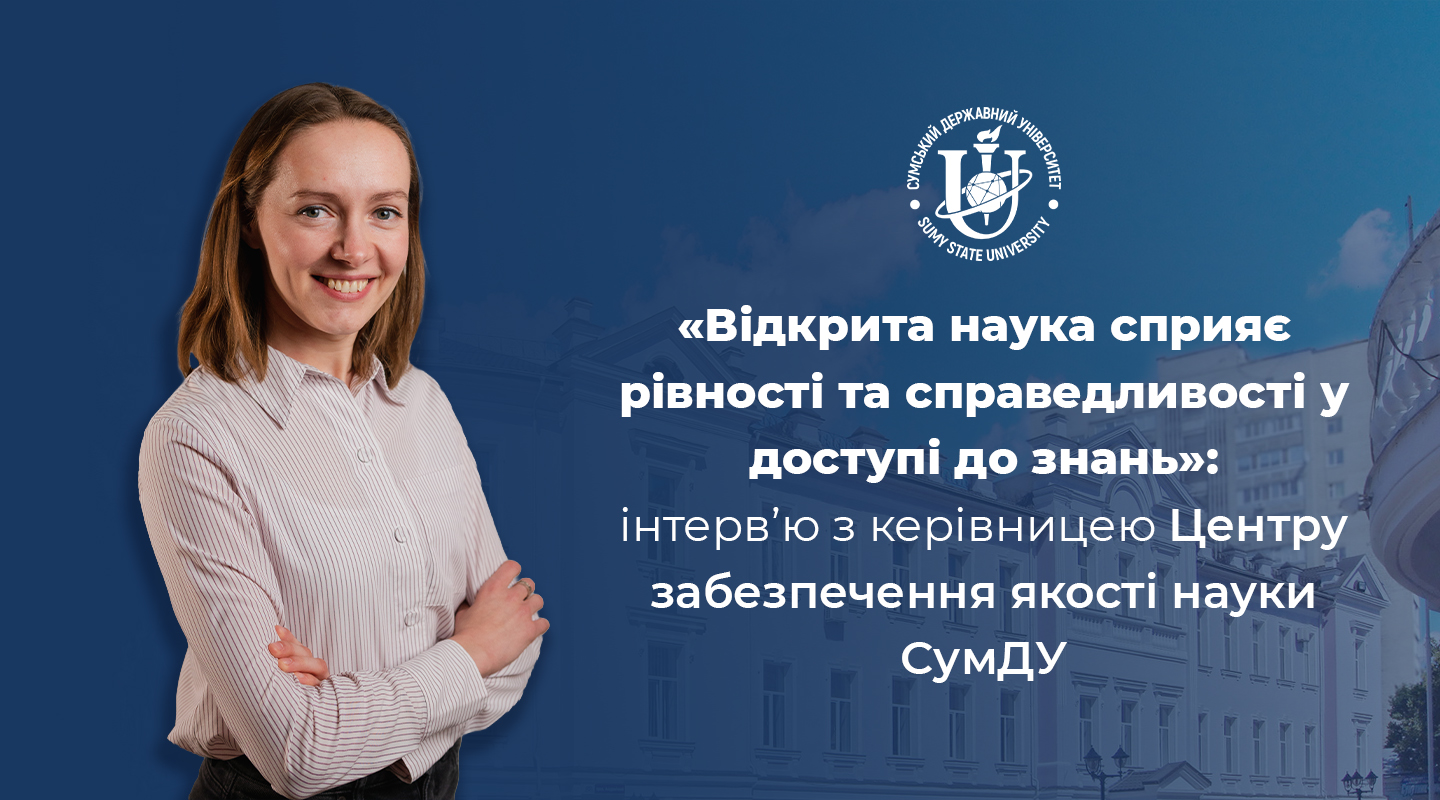
Olha KRAMARENKO (head of the SumDU Center for Scientific Quality Assurance) received the Certificate of Appreciation from the Ministry of Education and Science of Ukraine for significant contribution to development of regulatory framework for open science. We spoke about how new rules for Ukrainian science are being formed, which open science tools are already in use at SumDU, and why future of scientific research is inextricably linked to openness, transparency, and accessibility of knowledge.
Olha, we sincerely congratulate you on receiving the Certificate of Appreciation! You have been recognized for your active participation in development of the Ministry’s regulatory documents regarding implementation of open science principles. Since SumDU information resources are read not only by members of the academic community but also by a broad audience, please describe what open science is. Why are open access and principles of open science important for universities and researchers?
Thank you for your congratulations.
Open science is an approach where scientific knowledge, study results, data, publications, and research infrastructure become as accessible as possible to society, scientists, and educators.
Above all, open science promotes equality and fairness in access to knowledge. It enables researchers from different countries, regardless of their financial means, to access the latest scientific findings and fully participate in the international scientific community.
This is particularly relevant for Ukraine, as access to international scientific findings is often very expensive (downloading a single publication costs as much as 30 euros). This is precisely why open access is of strategic importance, as it enables researchers to work with current research even with limited resources.
Open science also entails open access to research infrastructure, particularly centers for shared use of scientific equipment. This approach expands opportunities for conducting high-quality research, promotes inter-university and international collaboration, and stimulates development of innovations.
In addition, openness of science enhances reproducibility and verifiability of scientific results, facilitates interdisciplinary collaboration, and creates conditions for new discoveries.
In the list of materials on open science on the Ministry website, your name appears among authors in virtually every document. Tell us about your involvement in creating the regulatory framework for open science in Ukraine.
Indeed, over the past few years, my professional work has been closely linked to development of open science and research data management in Ukraine.
It all began in 2024, when the Ministry of Education and Science approached SumDU as one of the country’s leading institutions of higher education with a proposal to delegate a representative to the working group on research data management.
At that time, SumDU already had a Center for Science Quality Assurance, one of whose areas of activity is implementation of open science practices and principles of proper research data management. That is why the university recommended me as an expert in this field.
In 2024, I became a member of the working group on research data management, established by Ministry Order No. 780 as of 30 May 2024. The group developed “Methodological Recommendations on Research Data Management for Higher Education Institutions and Research Organizations”. The document outlines approach to organizing work with research data, its preservation, reuse, and ensuring compliance with FAIR principles.
I was tasked with leading a subgroup to prepare methodological materials on development of research data management plans for universities and institutions. This is an extremely important area, as such plans are now one of fundamental elements of modern research culture and international grant practices.
In 2025, I was invited to join the working group on developing the professional standard “Research Data Management Specialist”. I contributed to shaping structure of professional qualifications and defining key job functions and competencies of future specialists who will work with research data at universities and institutions.
In addition to regulatory activities, I am the project manager of a nationwide initiative based at the State Scientific and Technical Library of Ukraine, dedicated to developing methodologies and tools for monitoring effectiveness of implementing open access principles and proper research data management. A number of methodological recommendations have already been prepared, and a series of webinars has been held for researchers and university staff on open science, data management, and intellectual property.
How are the principles of open science implemented in day-to-day work at SumDU? Can you provide specific examples?
For over a decade, SumDU has been systematically and consistently developing its own open science ecosystem, implementing open access practices for results of scientific and educational activities. At the same time, research data management practices have become a new stage in development of this area, which is now being actively implemented in university’s scientific activities in accordance with the FAIR principles.
SumDU became one of the first universities in Ukraine to introduce mandatory open-access publication of dissertations defended before the university’s specialized academic councils. Subsequently, this practice was extended to Bachelor’s and Master’s theses. All SumDU scientific journals operate under an open access model and use Creative Commons CC BY licenses, which complies with modern international standards of academic communication.
In addition, the university provides researchers with access to its own scientific infrastructure and equipment. This is facilitated by development of centers for collective use of scientific equipment, as well as expansion of a network for shared use of research infrastructure in collaboration with domestic and international partners.
During 2024–2025, the university transitioned from establishing the regulatory and organizational framework for research data management to practical implementation of relevant tools, digital solutions, and research practices.
In particular, the Open Science Policy, the Regulations on the Management of Research Data at SumDU, and an Institutional Data Management Plan template were created and realized at the university.
In accordance with international requirements and practices, particularly the Horizon Europe programs, the university has introduced preparation of data management plans for all state-funded research projects carried out at SumDU.
Another important step was implementation of open access practices for research data generated through projects, as well as development of SumDU’s research data environment based on the Dataverse UA repository.
What challenges do you face when organizing research data management processes and working with scientific publications?
The implementation of any new practices is always accompanied by certain challenges, and research data management is no exception.
For many researchers, preparing data management plans, organizing work with research data, and bringing them into compliance with FAIR standards are relatively new practices. They require not only a shift in approaches to organizing research but also additional resources, particularly funding from grant providers to support these processes.
It is important to understand that not all scientific results can be fully open. Issues related to personal data protection, intellectual property, or handling sensitive information often arise. Therefore, one of the key challenges is finding a balance between openness of science and compliance with legal requirements and ethical standards. In this context, development of researchers’ competencies in areas of research data management, open science, and intellectual property takes on particular importance.
Development of technical infrastructure remains a separate challenge, as effective data management requires modern digital solutions for storage, description, processing, and further analysis.
Regarding scientific publications, one of the most significant challenges remains high cost of publishing articles in international open-access journals. This highlights need for additional support and funding mechanisms for researchers, similar to those currently offered by international grant programs.
Which tools and open services at SumDU do you consider the most important for open science support?
Today, SumDU has established a comprehensive ecosystem of digital services and tools that ensure implementation of open science principles. First and foremost is the university’s institutional repository, which provides open access to publications, dissertations, qualification papers, research reports, and other scientific materials. Thanks to this, results of university’s scientific activities become accessible to the academic community and a wide range of users.
Another important element of the ecosystem is the research data environment based on Dataverse UA. It allows researchers to store, describe, and disseminate research data in accordance with the FAIR principles.
Besides, the university has developed the Research Data Management Service, which is integrated with SumDU’s unified scientific results management system. The service automates research data management processes: from preparing data management plans to collecting and organizing related metadata. The system also provides monitoring and analytics of data management processes, which improves their quality and efficiency.
And finally: how do you see open science development in Ukraine in the coming years, and what role do universities play in this process?
I am sure development of open science in Ukraine will only intensify in the coming years. It concerns integration of Ukrainian science into the European research area and a growing number of Ukrainian institutions and researchers participating in international grant projects.
International academic mobility also plays an important role. Today, many Ukrainian researchers have an opportunity to work at leading European universities, where they become familiar with modern open science practices, approaches to research organization, data management, and scientific collaboration. In future, this experience will be integrated into activities of Ukrainian universities and institutions.
At the same time, development of open science involves more than just creating digital solutions or implementing regulatory requirements. Above all, it entails a shift in culture of scientific activity, increased accountability for research outcomes, and willingness to engage in open collaboration within the scientific community.
Universities play a key role in this process, as they not only conduct research but also shape a new generation of researchers. Today, universities must focus on building a comprehensive open science ecosystem that encompasses development of policies, research infrastructure, academic culture, and necessary competencies.
In my opinion, Ukrainian universities are already demonstrating positive changes in this direction. It is very important that, even in face of current challenges, the scientific community is moving toward openness, transparency, and responsible dissemination of knowledge.