

 укр
укр  eng
eng 

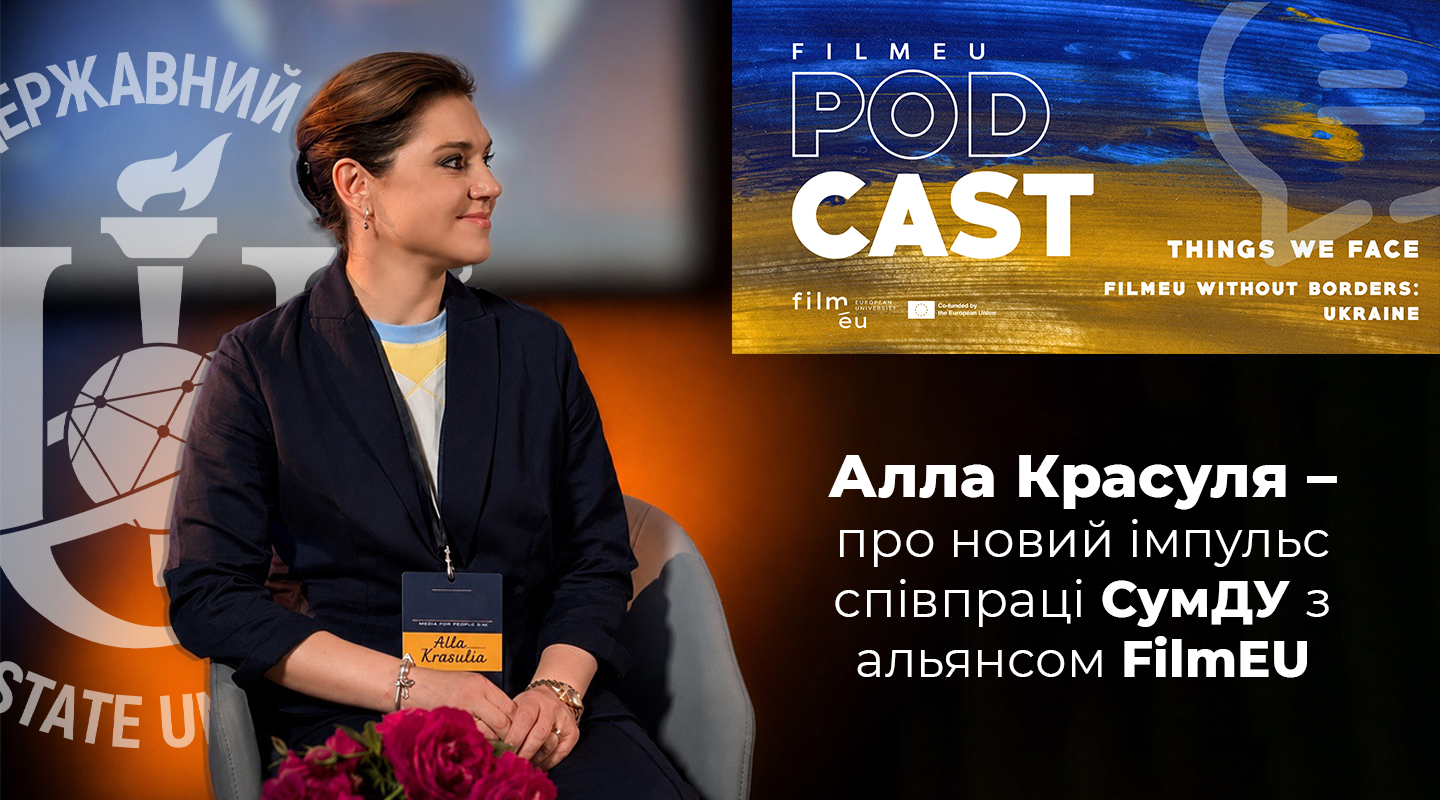
International partnerships are built not only through grants and formal agreements, but above all through people who are willing to trust one another and work towards a shared goal. This is exactly how the collaboration between Sumy State University and the FilmEU European University Alliance evolved, resulting in the international project FilmEU Without Borders – Ukraine. Through the personal stories of SumDU students, academics, and staff, the project introduces European audiences to a Ukrainian university that continues to teach, learn, innovate, and create new opportunities despite the realities of war. In this interview, Dr. Alla Krasulia, Head of the International Relations Office at Sumy State University, reflects on how the project came to life, what it means for the university, and the prospects for future cooperation.
– Today, Sumy State University is actively developing cooperation with several European University Alliances, including E³UDRES², NEOLAiA, and FilmEU. While the first two are already well known within the university community, cooperation with FilmEU is only beginning to gain momentum.
How did this story begin?
– In many ways, this is not the story of a single project. It is the story of rebuilding trust and renewing a partnership.
Our collaboration with FilmEU actually dates back to the DESTIN project, when the Department of Journalism and Philology worked closely with European partners. As often happens, teams changed, priorities shifted, and, of course, the war fundamentally reshaped the reality of Ukrainian universities. Yet the human connections remained.
When I became Head of the International Relations Office, one of my priorities was not only to establish new international partnerships but also to revive those with a strong foundation.
– Was FilmEU one of those partnerships?
– Yes, FilmEU was one of them, although this story actually began much earlier.
From the very beginning, I invited colleagues from the Department of Journalism and Philology to join this initiative. Dr. Maryna Sadivnycha and Dr. Nataliia Ponomarenko became invaluable partners, helping coordinate communication within the department and supporting the project throughout every stage of its development. I am also sincerely grateful to Prof. Volodymyr Sadivnychyi, Head of the Department, and Dr. Olena Sushkova, Dean of the Faculty of Foreign Philology and Social Communications, for their belief in this initiative and for supporting it from the outset.
Following numerous meetings with our FilmEU colleagues, extensive discussions, and careful preparation, Vice-Rector Prof. Ivan Kozii and I attended the Alliance's International Relations Offices meeting. There, we presented Sumy State University's international profile, shared our experience of operating during wartime, and discussed opportunities for academic mobility, joint educational initiatives, and future international cooperation.
That meeting marked an important turning point. It provided the institutional support we needed to turn ideas into concrete collaborative initiatives. From that moment on, our partnership with FilmEU gained new momentum.
Today, I am especially pleased that we can already speak about the first successfully completed joint project – a project that demonstrates what can be achieved when trust, commitment, and shared values come together.
– What makes this project even more remarkable is that it was carried out without dedicated funding, wasn't it?
– Absolutely. In fact, I think this is worth emphasizing. T
The entire process – from developing the initial idea and discussing it with our partners, to refining the concept, coordinating recordings across several countries, managing communication between universities, scheduling interviews, supporting participants, and finally releasing the podcast series – was accomplished entirely on a voluntary basis.
This was one of those projects where enthusiasm, mutual trust, and a genuine desire to create something meaningful became the driving force. And that is precisely why this project holds such special value for me.
– Could you tell us more about the idea behind the podcast series?
– The original concept was born within the FilmEU community. The podcast was envisioned as a platform where students and alumni of European universities could openly discuss their professional journeys, creativity, challenges, international collaboration, and life as emerging filmmakers and media professionals. Its mission was to support young creatives, help them navigate professional challenges, and foster a sense of European community through personal stories.
During our conversations with FilmEU colleagues, we were invited to contribute to a special series entitled FilmEU Without Borders – Ukraine.
Outside Ukraine, people often learn about our country through statistics, headlines, and reports on the war. We wanted to tell a different story – not through numbers or dramatic headlines, but through the voices of real people.
We wanted European audiences to meet ordinary students, academics, and university staff who continue to study, teach, build international partnerships, and create new opportunities despite air raid sirens, shelling, and constant uncertainty.
This is how the idea of four personal stories emerged, marking four years since the start of Russia's full-scale invasion of Ukraine.
– The podcast features four representatives of Sumy State University, most of them from the Faculty of Foreign Philology and Social Communications.
Why were they chosen?
– It was actually a very difficult decision. From the very beginning, our FilmEU colleagues told us that they were not looking for a general story about a university at war. They wanted to hear the voices of real people – those working in journalism, communication, translation, languages, and international cooperation. People whose professional lives revolve around telling stories, fostering dialogue, and helping others make sense of the world around them.
We spent a long time considering whom to invite. Sharing your personal experience of living through war is never easy. It requires courage, and not everyone feels ready to speak so openly to an international audience.
In the end, we chose four very different stories that together paint a multifaceted picture of our university. They represent a student journalist, a translation student, an academic, and an international relations professional. Four different perspectives, united by one common purpose: their commitment to Sumy State University and their willingness to honestly share with the world what higher education in Ukraine looks like today.
Zakhar Iuvko represents a generation of journalism students coming of age in wartime. A Master's student in Journalism at Sumy State University and a journalist with the Sumy-based media outlet CUKR, Zakhar embodies the experience of young Ukrainians whose professional journeys have unfolded during Russia's full-scale invasion.
In conversation with Regina Zagoni, a student at the Institute of Art, Design and Technology (IADT), Ireland, he reflects on university life, the first steps in his career, growing up in a frontline city, and how war reshapes a young person's worldview. Their episode is an honest dialogue between two students from different countries seeking to better understand each other's realities.
Anna Markhel shares a story of difficult choices and the continuity of education. A student in the Department of Germanic Philology and a future translator, Anna was forced to relocate to Poland because of the war. Despite this, she continued her studies at Sumy State University online, remaining an active member of the university community.
In her conversation with Oksana Babych, a student at VIA University College, Denmark, Anna speaks about forced displacement, staying connected to her home university, preserving her identity, and her hopes for the future of Ukraine's younger generation.
Olena Bondarenko's episode explores education as a form of resistance. Associate Professor Olena Bondarenko, Vice-Dean of the Faculty of Foreign Philology and Social Communications, shares the perspective of an educator who continues to support students every day despite the realities of war.
This is perhaps one of the most emotional episodes in the series. Olena reflects not only on teaching under constant threat but also on the responsibility of an educator, the power of education as an act of resilience, the importance of supporting the student community, and her own family's experience, with loved ones currently serving in the Armed Forces of Ukraine. Her interviewer is Anastasiya Maksymchuk, a Ukrainian filmmaker, researcher, and lecturer at Lusófona University in Portugal.
I was also invited to participate in the project. In my episode, I share the story of international cooperation under the sound of air raid sirens. My perspective differs from the others because it reflects the experience of someone who combines several professional roles – lecturer, researcher, and Head of the International Relations Office at Sumy State University.
Our conversation explores how the university continues to build international partnerships, participate in European projects, and develop new academic collaborations while operating just 30 kilometres from the Russian border. It is also a deeply personal story – about the losses our university community has endured, the spaces destroyed by war, and, at the same time, the new opportunities made possible through international solidarity.
Today, international cooperation is about much more than internationalisation. It is about trust, support, resilience, human connections, and our shared responsibility for the future of Ukrainian higher education.
– Each podcast also featured a European interviewer. How important was that aspect of the project?
– I believe it became one of the project's greatest strengths. Every Ukrainian story was met by someone from another country. As a result, these conversations became much more than stories about war – they became genuine dialogues built on trust, empathy, and a willingness to understand one another.
I am deeply grateful to Linda Carroll and Christina Reynolds for believing in this initiative from the very beginning, for their unwavering support, and for their commitment to making Ukrainian stories part of the wider European conversation within FilmEU.
My special thanks also go to Anastasiya Maksymchuk (Lusófona University, Portugal), the creator of the FilmEU Podcast Club concept and the FilmEU Without Borders – Ukraine special edition. She became the bridge that connected Sumy State University and FilmEU, accompanying this project from its initial idea through to its successful completion.
And, of course, I would like to thank all the student journalists and interviewers who approached these conversations with such professionalism, sensitivity, and genuine curiosity. In particular, I would like to acknowledge Hristina Yosifova (NATFA, Bulgaria), who conducted my interview with exceptional professionalism, empathy, and warmth.
These are exactly the kinds of conversations that build understanding – not only between individuals, but also between countries.
– One of the distinctive features of the project was the active involvement of students from FilmEU partner universities. In your opinion, what did this international student collaboration bring to the project?
– I believe that is exactly what made this project so special. It was not created for students – it was created with students.
I would like to thank Zakhar Iuvko and Anna Markhel for their courage in sharing their personal stories. My sincere appreciation also goes to all the student journalists and interviewers who contributed to organising the recordings, preparing the materials, facilitating communication, and supporting the project throughout its development.
Initiatives like this remind us that international cooperation is about much more than institutional agreements. Above all, it is about people.
– What does this project mean for Sumy State University?
– For me, it represents far more than a series of four podcasts. It demonstrates that even a university located just a few dozen kilometres from the frontline can remain an active and valued member of the European Higher Education community.
This project demonstrates how international cooperation can serve as humanitarian diplomacy. Perhaps most importantly, however, it is only the beginning.
We are already discussing new joint initiatives with FilmEU, including SumDU's participation in the Podcast Club, new academic activities, expanded mobility opportunities, collaboration within Creative Europe, and other international projects that will create even more opportunities for our students and staff.
I hope this story will serve as a reminder that meaningful international partnerships do not begin with grants or funding alone.
They begin with people who are willing to trust one another, believe in a shared vision, and work together to make it a reality.
Listen to the FilmEU Without Borders – Ukraine podcast series:
Ep1 | FilmEU Podcast Special Edition: FilmEU Without Borders – Ukraine | Sumy/Dublin. Zakhar Iuvko
Ep2 | Special Edition: FilmEU Without Borders – Ukraine | Sumy/Sofia. Dr Alla Krasulia
Ep3 | Special Edition: FilmEU Without Borders – Ukraine | Sumy/Aarhus. Student Anna Markhel
Ep4 | Special Edition: FilmEU Without Borders – Ukraine | Sumy/Lisbon. Dr Olena Bondarenko